How to Set Up a Proxy in Multilogin
Connect an external proxy through the Custom option in a Multilogin browser profile. Match the protocol and credentials to your issued endpoint, then check the connection before using the profile.
Documentation reviewed 31 October 2026 · Proxyca setup guide
Get your Proxyca connection details
Residential proxies
Buy a GB package. Open My proxies → Generate, choose quantity, country, city, protocol and rotation or sticky settings, then generate your connections.
Datacenter proxies
Open Static proxies, choose country, IP quantity and rental period, then pay. Open the issued order in My proxies.
Copy the host, port, username and password for one connection. The hostname:port:username:password format puts those four fields in that order. In a browser with separate fields, paste each value into its matching field and select the issued protocol.
Have the issued endpoint ready
Open the connection details supplied with your proxy order. Keep the host, port, protocol and any username and password together. Use the values for the same endpoint; do not combine a port from an example with credentials from an order.
A hostname is entered as issued. A port is a connection setting, not an IP address. When authentication is required, the proxy username and password are separate from your Multilogin account login. Keep them out of screenshots you send to a public forum.
Use Custom for an external provider
- Open Profiles → Browser and create or edit the browser profile you want to configure. Open its Proxy section.
- Choose Custom. The built-in Multilogin option uses a different product; selecting it does not import your Proxyca order.
- Select the protocol specified for your endpoint: HTTP, HTTPS or SOCKS5. Enter the proxy as host:port:login:password, or host:port when the endpoint uses IP authentication.
- Let the automatic check finish. Multilogin reports Proxy check passed or Proxy check failed. Save the profile configuration after reviewing the result.
Menu labels can vary by version. These instructions follow the Multilogin custom HTTP and SOCKS proxy guide.
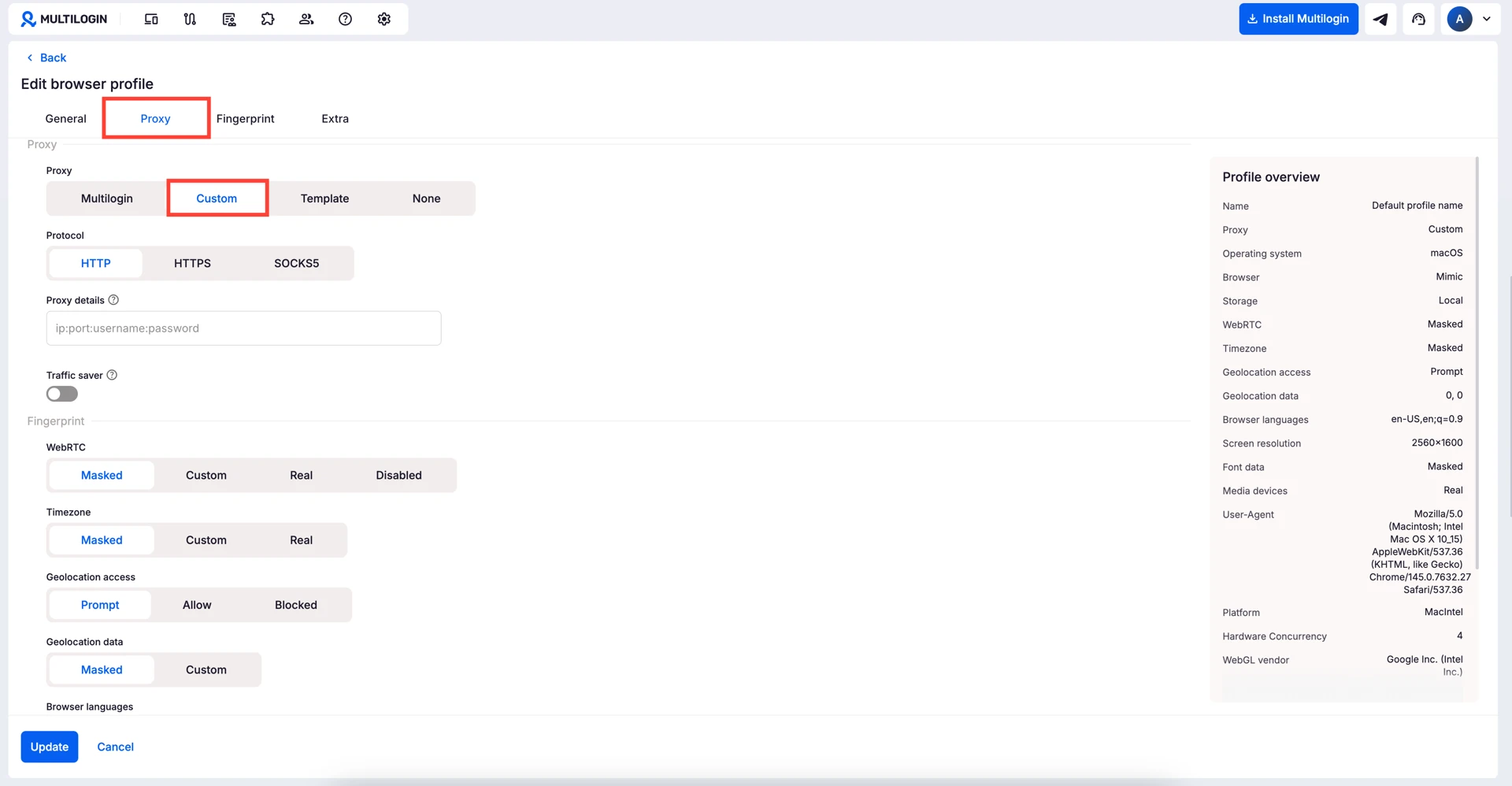
Separate profile mode from proxy authentication
Custom, Multilogin, Template and None are separate connection choices in the browser-profile settings. None uses the device’s current connection; Template reuses saved proxy settings. These names describe how the profile gets its configuration, not whether your external order is paid or active.
For your first check, keep the record simple: a named browser profile and one known endpoint. Write down which profile you edited before launching it. If you later reuse a template, inspect the resulting endpoint rather than assuming the template still contains the latest order details.
What the proxy controls look like
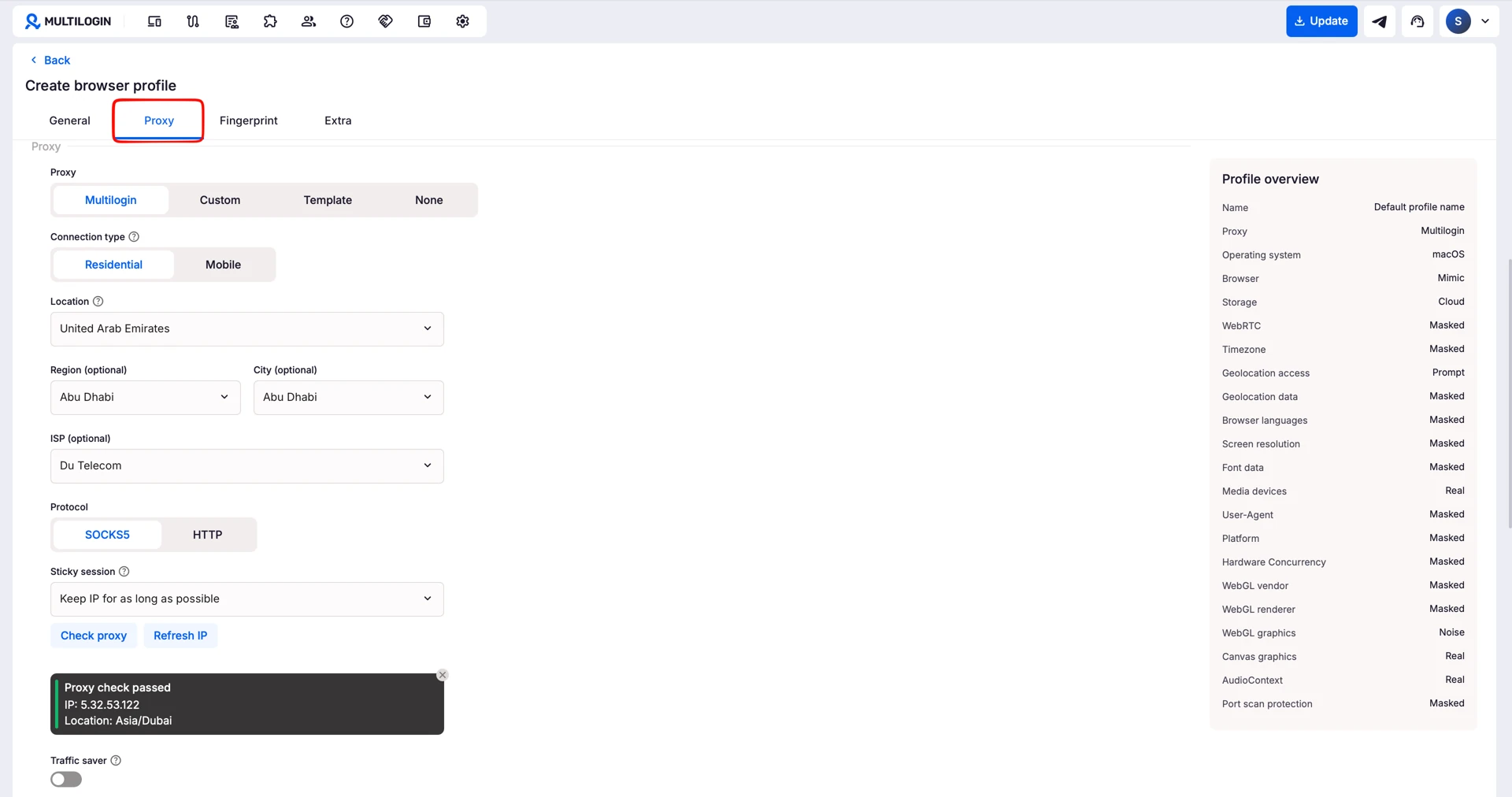
The images show the developer’s documented interface. Example credentials or profile names in them are not a Proxyca endpoint; enter the details issued with your own order.
Compare the checker with the launched profile
Treat Proxy check passed as a successful Multilogin connection check. It does not establish that every destination will accept requests. Launch the saved browser profile and open an IP lookup inside that window. A lookup in your ordinary browser would test a different connection.
Record the profile name, observed address, lookup URL and test time. Then open the page you actually need. Keep the two results separate: an IP lookup describes its own request, while the destination may return a sign-in challenge, an access restriction or an application error.
If the checker fails, compare the four issued values with the saved entry before changing anything else. If the checker passes but the target fails, record the target URL and visible error. This gives support a reproducible question rather than a general report that the proxy is broken.
The public IP tool checks the request from the browser window where you open it. It does not test an endpoint configured only in another application.
If the first attempt fails
Change one setting at a time and repeat the same request. Start with typing or paste errors, the selected protocol, and the active order. When an import string parses unexpectedly, inspect its fields rather than repeatedly pasting the whole value.
For an HTTP proxy response of 407, investigate proxy authentication. A different destination error needs its own diagnosis; a failing page alone does not identify which component rejected the request. See the connection testing guide for a fuller sequence.
To troubleshoot the connection, record the order number, application version, endpoint host and port, selected protocol, test time and exact error. Redact passwords and tokens. State whether the failure happens in the checker, the launched profile or only one destination.
Multilogin proxy questions
Does this guide cover Multilogin cloud phones?
No. These steps concern browser profiles. Multilogin documents separate proxy settings for its cloud-phone product; do not assume the browser-profile menu applies there.
Should I select Multilogin to use a Proxyca endpoint?
Choose Custom for the external endpoint described here. The Multilogin option is for its built-in proxy product.
What does an automatic check prove?
It reports the result of that connection check. Continue with a request inside the launched profile and a separate check of your intended destination.
Choose a product for your connection requirements
Compare the available plans by billing unit, required location and application compatibility. A successful proxy connection is not a guarantee that a website will accept an account or request. Use the service within the destination’s rules and your authorization.
All application setup guides include the existing AdsPower walkthrough. For current interface details, also see Multilogin profile Proxy section.
Choose a proxy for your browser profiles
Use residential traffic for country and city settings, rotation or sticky sessions. Start with 1 GB for $8, then generate connections in Telegram. Choose datacenter rental when your profile needs a static rented IP: from $2.50 per IP for 30 days.
Residential packages → · Static IP plans → · Test your connection →